The Care-Control Gap: A Place We Live in Without Knowing It
If someone is drowning and you can’t reach them, that’s a horrific experience. It’s direct, acute, and time-bound. Your body knows exactly what’s happening.
The Care–Control Gap — as I’m calling it — is different.
It’s more like a sustained version of that helpless witnessing of suffering, sometimes on the other side of the world, stretched over months and years, often without a single moment you can point to.
It’s subtle enough that you might not consciously name it.
But especially if you’re someone who finds it hard not to do anything, you might simply live with the symptoms: chronic tension, fatigue that sleep doesn’t fix, irritability, urgency, cynicism, or a strange numbness.
Sometimes people say,
“Nothing is really wrong in my life, but something feels deeply off.”
Yes. That.
I want to offer a simple way of holding this — not as a grand theory or a new psychological model, but as a grounded pointer. Something you can use lightly. Something that might help you recognise what is already happening in you.
And I want to talk about the Care–Control Gap as if it were a place. It’s obviously not a literal place, but imagining it that way can make it easier to notice, inhabit, and stop fighting.
A space between what we care about and what we can control
At its core, the Care–Control Gap is the psychological space between what hurts to witness and the influence we realistically have over outcomes.
That’s the whole structure.
When care is consistently high and control is limited, the mind tries to resolve the mismatch — not once, but over and over again. It does this through very human, but largely ineffective strategies: ramped-up urgency, self-blame, overfunctioning, or numbing.
Because of the overlapping crises we’re facing, I think of the Gap as systemic, not personal.
Why it’s hard to name
The Gap reminds me of grief, or of solastalgia — deeply intimate, widely shared, and strangely difficult to articulate without some kind of container.
You feel it sharply, yet you’re not always able to explain it clearly. And it doesn’t necessarily look like “something happening” on the outside.
And yet, I find that people I work with — especially purpose-driven professionals — often recognise it immediately when it’s named, and express a kind of relief.
If you’re familiar with the psychological work around changemaking, you might recognise this territory in terms like climate anxiety, ecological grief, or moral distress. I’m not offering a competing label, but a different entry point: a more systemic, spatial way of relating to the same terrain.
For me, it’s like the difference between describing everything inside a house and first realising that you’re in a house at all — gaining orientation before diving into what’s happening inside.
What the Gap feels like (without over-analysing it)
With that orientation in mind — and without trying to pin it down — here’s how the Gap often shows up.
(The point isn’t to dissect it to death, but to legitimise it and let you notice what it means for you).
Often, the Gap comes with a mix of outrage, fear, guilt, powerlessness (often a mix of those), and a low-grade dread or agitation — that constant background hum. You may also feel lost, disorientated, or displaced.
Underneath all of it is something very simple and very human:
This is awful. I am worried. And I can’t control this.
The two escape routes

When the Gap becomes too uncomfortable, most of us shuffle to one side or the other.
One route is disassociating or checking out: scrolling, extreme exercising, substances, dopamine chasing — or even spiritual practices and forced optimism used to disappear, rather than be present.
The other route is over-responsibility or over-functioning: fixating on what’s wrong with the world or with ourselves, carrying the weight of everything, rushing life, urgency addiction, chronic tension. The belief that if I just do more, maybe this will feel better.
If you’re reading this, you may recognise yourself more in the latter. But both are understandable attempts to regulate an impossible load. And in the end, neither is stabilising.
This isn’t a superhero story
There’s a part of this that makes me think of superhero movies. When the world starts coming to an end and a huge crack opens up, the hero’s job is clear: jump across it, seal it, save everyone.
I think many of us, especially those trying to make a positive difference, have absorbed that logic without noticing.
Navigating the Care–Control Gap asks for something different — almost an anti-hero role. Not fixing it directly, but staying present inside it, in order to discover what can’t be found on solid ground.
A different way of relating to the Gap
Because of my own process, I’m not interested in solving the Care–Control Gap anymore. For me, that tends to turn it into another stress-inducing pursuit, with no satisfactory outcome. And this is consolidating in my work as a coach.
What I’m interested in is building the capacity to stay human, present, and intact inside it.
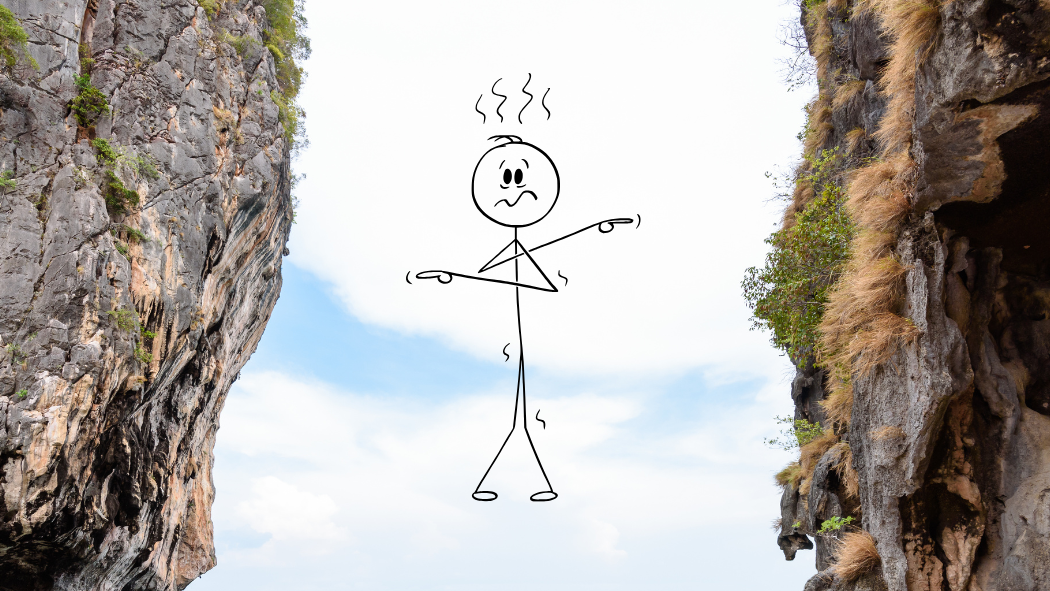
It helps to imagine the Gap as a wide space between two cliffs. One side is numbing and disengagement. The other is the martyrdom and burnout.
When we avoid this space in between, something in us may start to feel false. When people tell me they’ve lost a sense of purpose or don’t know who they really are anymore, I hear that as a sign.
I would never force anyone into this space. Falling into it without awareness can feel overwhelming. But when we learn to stand there on purpose, something may shift.
This is where the Gap can become a kind of portal, to a deeper sense of inner autonomy and groundedness. Not feeling good or peaceful always, but more true. A place where we begin to distinguish what is ours to care for from what is ours to carry. With that, you can cultivate more resilience.
And eventually, it will help answer the question: What is mine to do here?
A few ways to use the Gap to build resilience
Here are some ways I find are supportive to navigate this Gap more confidently - and feel not necessarily happier, but more honest and more whole.
Name it.
“I’m in the Care–Control Gap. My care is high, my control is limited.”Get curious about ‘powerlessness’.
Where is it in the body? What is it actually made of?Use both/and language.
“This is heartbreaking, and I can take one meaningful step.”
“I care, and this is not all my responsibility.”Separate contribution from outcome.
My job is contribution, not a solution.Return to relationship.
The Gap becomes unbearable in isolation; seek out people to share this with.Make space for grief.
You’ll be amazed how much you can take if you don’t block yourself to feel that.
Essentially, it’s just about becoming aware of the space you may already be living in — and finding a way to stand there with more steadiness.
For me, this awareness keeps returning to a simple realisation:
Change work asks us to keep caring.
Systems reality can train us to surrender.
If you recognise yourself in all of this, know this: what you’re feeling isn’t strange, and it isn’t weakness. It’s not even personal. Perhaps the biggest favour you can do for yourself — and for the world — is to let your nervous system meet reality, learning slowly how to stay present in a time that doesn’t offer the comfort of control or clear resolution.
****
I work with people who want to stay grounded while doing meaningful work — through one-to-one coaching and the Impact Sweet Spot™ Programme.
If you’re curious, you’re welcome to book a conversation and see whether working together feels like a good next step.