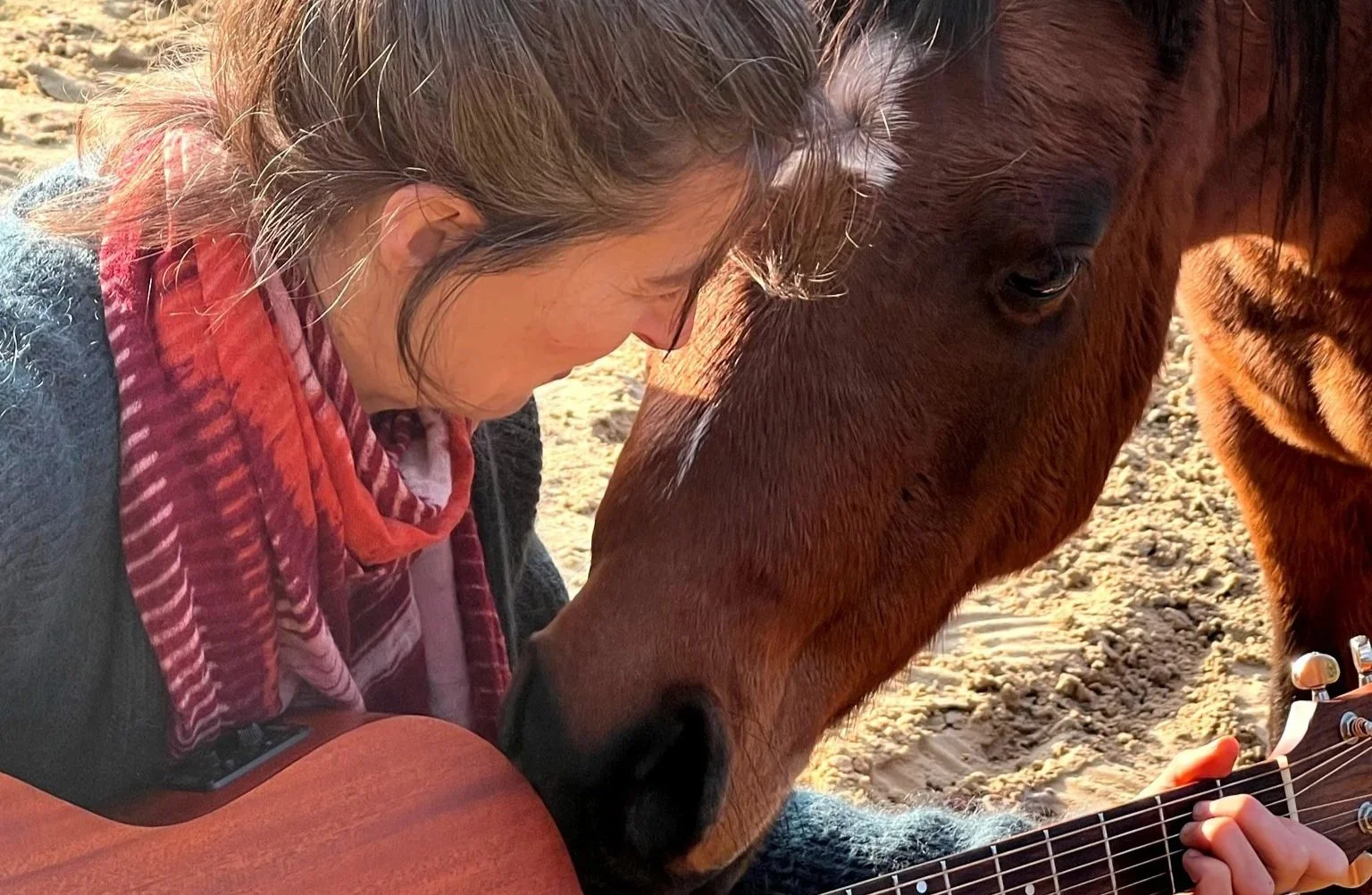
(This is me playing the guitar to my friends’ horse Gigi. Horses are such honest reflectors. It’s like they know exactly when you’re authentic and when you’re subtly performing.)
Breaking the spell
It was one of those ordinary mornings that changed something substantial in my life and my work. I was walking my dog in our favourite park. Mid-thought, I suddenly became aware of something I'd been doing for a very long time without quite seeing it that lucidly.
Basically, I’d made an art out of constantly telling myself I was missing something. That something about me was never up to scratch.
I said out loud: I've had it! I was completely fed up with undermining myself. It felt like a bitter taste in my mouth. Why am I doing this to myself? And who on earth is it helping? Looking a little deeper, I found a familiar, old insecurity. A sticky, stubborn one. One that started in my early years, as most of these things do. The story that how I was, was not quite right.
Most of us walk around with some version of this. I'd say it's pervasive — across cultures, across upbringings, even across relatively happy childhoods. We are told, in a thousand small ways, that who we are needs adjusting.
But here’s where it gets salient for us changemakers. When you’re working on social or environmental crises — trying to fix broken systems, reduce harm, contribute meaningready-madefully — it has a particular texture.
Because the problems you are working on are bigger than you can solve. That's just true. And if you are already running a background programme of not enough, then dedicating your life to something unfixable feeds directly into it. It feeds into the wound already there.
That morning in the park, a spell had been broken. I had exposed my saviourism a long time ago, but I had not yet felt (so viscerally) how my self-criticism was undermining my capacity to contribute. It became a turning point, in how I related to myself, and in what eventually became Impact Sweet Spot.
Finding your frequency
I came to see that one of the most powerful and underrated things you can do to tackle this ongoing self-criticism, is to get to know yourself — freshly. Not with the goal to improve yourself, or become a better version of yourself, but to actually look clearly at who you already are.
Think of it as finding your frequency. Like a radio being constantly tuned — just slightly off, always seeking, never quite landing. That is what it feels like to live in that low-level self-doubt. It's subtle enough that you often don't realise how much energy it's taking. And when the dial finds the right position, the static clears. Something in your system can rest.
That's what I mean by getting to know yourself. This is not the same as navel-gazing, or endless self-analysis. Something sweeter than that. It's a recognition. Oh. This is who I am.
Practically, this can start with looking back. Your life already contains an abundance of clues — if you know how to read them.
What did you gravitate toward, before anyone told you what to gravitate toward? What gave you energy, not because you were praised for it, but because it simply felt right? What have you kept coming back to, across different jobs, different contexts, different decades? Who do you collect around you, and what does that tell you about what you value?
The answers to these questions don't give you a ready-made career plan. But they give you something more durable: a clearer idea of what is yours to bring. Your natural strengths. What you actually stand for. Who you do your best work with and for.
And from that, gradually, something that feels like a natural confidence can begin to emerge. One that you can’t perform your way into. It doesn't come from credentials or status. It's more stable, and holds even when the system round you is failing. It's the kind that helps you say goodbye to what you thought you had to be.
(And for those who find that settling happens, once the noise quiets and you're less at war with yourself, there can be something even more profound. A connection to something larger than your individual character. I won't go into that here. But it's worth knowing it exists.)
Nearing 2027, the stakes feel high
This matters especially, I think, at the mid-to-late point of a career. The personal stakes feel higher, the commitments bigger, the years invested. And we are also living through a moment when the stakes for the world feel higher too. Most people, facing both, will just try to manage — to avoid rocking the boat, to avoid making difficult decisions. But there are a few who really want to change something fundamental — in themselves, and in how they show up in the world. Maybe that’s you.
Know thyself, said Socrates. He meant this, among others, as a way to bring integrity and clarity to how you act in the world. I believe this is life's work. And it's essential if you feel you have more to give. Or if you are simply tired of your own shoulds and shouldn’ts. And you’re ready to get acquainted with a different way.
I don't think this is a project with an end point. But I do think there are thresholds. Moments when something in you shifts. Moments when you stop tuning frantically, and find the frequency that settles something.
It can feel strange at first, because it feels so familiar.
******
I am now offering “Impact Sweet Spot Navigator”, a new programme that is a more compact version of the Leadership Programme. It is focused on career coaching, and it’s for people at exactly the crossroads described above: to give you practical clarity on who you are, what you stand for, and where your contribution fits.
If this interests you, I'd love to tell you more (and send you the brochure). Just book a free call here.